Phát triển và xác thực thang đo năng lực số của sinh viên sư phạm Việt Nam: nghiên cứu định lượng bằng EFA và CFA
Tóm tắt
With the aim of developing a digital competency (DC) framework for Vietnamese pre-service teachers (PSTs), this study constructed and validated a multidimensional DC scale for Vietnamese PSTs. Developed from international frameworks and local contexts, the toolkit was surveyed on 1,439 PSTs. Exploratory factor analysis revealed a robust five-factor structure, namely Digital technology use, Digital safety and ethics, Online emotion management and conflict resolution, Online communication and interaction, Digital content creation and expression, explaining 62.5% of variance with high reliability (α = .87-.91). Confirmatory factor analysis confirmed the model's good fit (χ²/df = 4.815, CFI/TLI>.91, RMSEA = .052), strong convergent and discriminant validity. The emergence of the Online emotion management and conflict resolution factor is also a new contribution, emphasizing the socio - emotional aspect of DC.
Tài liệu tham khảo
An Biên Thuỳ, Nguyễn Thị Lan Ngọc, Trịnh Thị Phương Thảo (2024). Đề xuất khung năng lực số cho sinh viên sư phạm tại Việt Nam. Tạp chí Giáo dục, 24(22), 1-6.
Audrin, C., & Audrin, B. (2022). Key factors in digital literacy in learning and education: A systematic literature review using text mining. Education and Information Technologies, 27(6), 7395-7419. https://doi.org/10.1007/s10639-021-10832-5
Falloon, G. (2020). From digital literacy to digital competence: the teacher digital competency (TDC) framework. Educational Technology Research and Development, 68(5), 2449-2472. https://doi.org/10.1007/s11423-020-09767-4
Fornell, C., & Larcker, D. F. (1981). Evaluating structural equation models with unobservable variables and measurement error. Journal of Marketing Research, 18(1), 39-50.
Ghomi, M., & Redecker, C. (2019). Digital competence of educators (DigCompEdu): Development and evaluation of a self-assessment instrument for teachers’ digital competence. In Proceedings of the 11th International Conference on Computer Supported Education (Vol. 1, pp. 541-548). SCITEPRESS. https://doi.org/10.5220/0007679005410548
Hair, J. F., Black, W. C., Babin, B. J., & Anderson, R. E. (2019). Multivariate data analysis (8th ed.). Cengage Learning.
Hu, L. T., & Bentler, P. M. (1999). Cutoff criteria for fit indexes in covariance structure analysis: Conventional criteria versus new alternatives. Structural Equation Modeling: A Multidisciplinary Journal, 6(1), 1-55.
Instefjord, E. J., & Munthe, E. (2017). Educating digitally competent teachers: A study of integration of professional digital competence in teacher education. Teaching and Teacher Education, 67, 37-45. https://doi.org/10.1016/j.tate.2017.05.016
International Society for Technology in Education (2017). ISTE standards for educators. https://www.iste.org/standards/for-educators
Lucas, M., Bem-Haja, P., Siddiq, F., Moreira, A., & Redecker, C. (2021). The relation between in-service teachers' digital competence and personal and contextual factors: What matters most? Computers & Education, 160, 104052. https://doi.org/10.1016/j.compedu.2020.104052
Nguyễn Trung Kiền (2025). Tổng quan các nghiên cứu phát triển năng lực số cho sinh viên đại học ngành Giáo dục tiểu học. Tạp chí Khoa học Giáo dục Việt Nam, 21(3), 65-72.
Redecker, C. (2017). European Framework for the Digital Competence of Educators: DigCompEdu. Publications Office of the European Union. https://doi.org/10.2760/159770
Siddiq, F., Hatlevik, O. E., Olsen, R. V., Throndsen, I., & Scherer, R. (2016). Taking a future perspective by learning from the past - A systematic review of assessment instruments that aim to measure primary and secondary school students' ICT literacy. Educational Research Review, 19, 58-84. https://doi.org/10.1016/j.edurev.2016.05.002
Trần Đức Hoà, Đỗ Văn Hùng (2021). Khung năng lực số cho sinh viên Việt Nam trong bối cảnh chuyển đổi số. Tạp chí Thông tin và Tư liệu, 1, 12-21.
Tzafilkou, K., Perifanou, M., & Economides, A. A. (2022). Development and validation of students’ digital competence scale (SDiCoS). International Journal of Educational Technology in Higher Education, 19(1), 30.
UNESCO (2018). UNESCO ICT Competency Framework for Teachers. United Nations Educational, Scientific and Cultural Organization.
UNESCO (2019). Digital kids Asia-Pacific: insights into children’s digital citizenship. France and UNESCO Bangkok Office. https://unesdoc.unesco.org/ark:/48223/pf0000367985
Vuorikari, R., Kluzer, S., & Punie, Y. (2022). DigComp 2.2: The Digital Competence Framework for Citizens - With new examples of knowledge, skills and attitudes. Publications Office of the European Union. https://doi.org/10.2760/490274
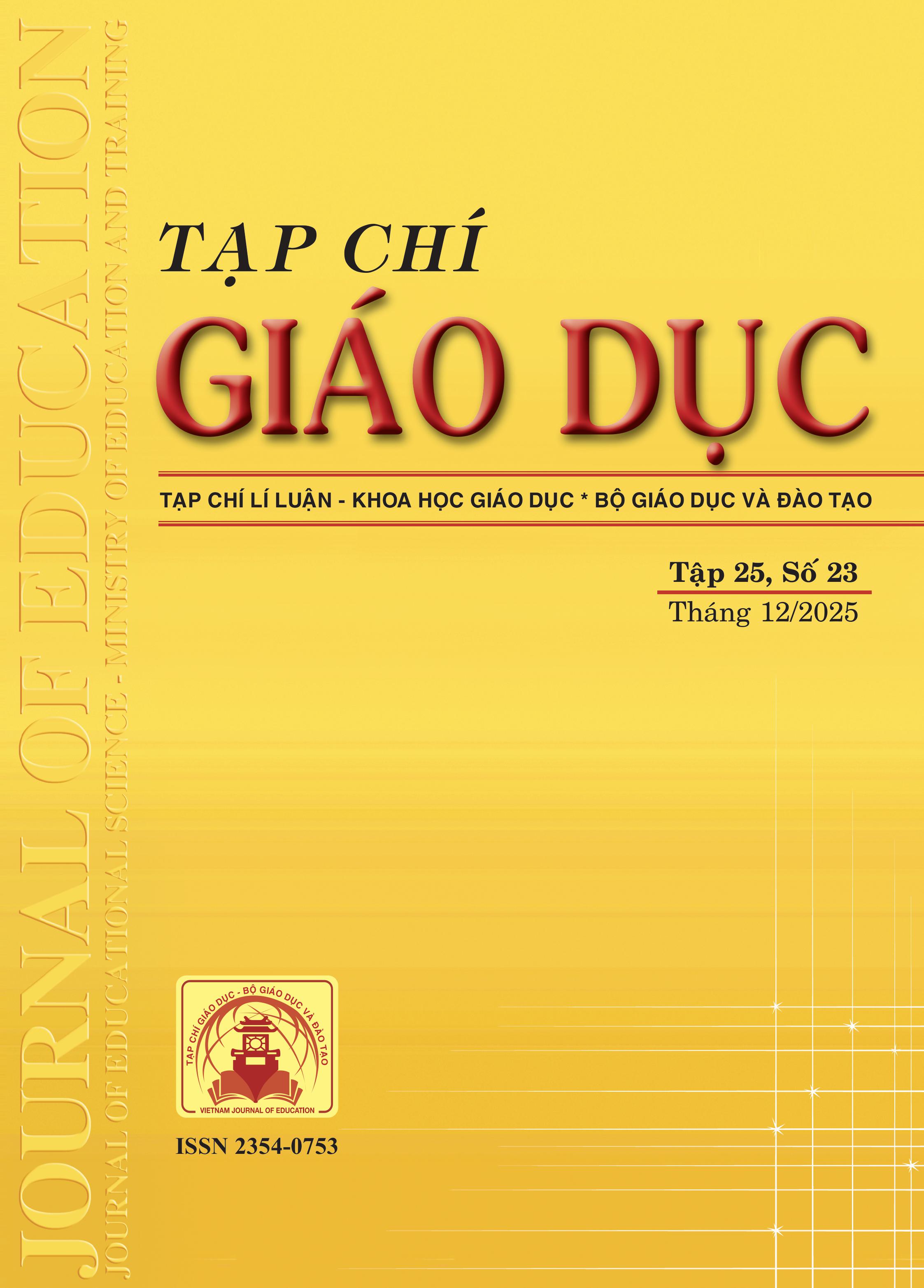
Tải xuống
Đã Xuất bản
Cách trích dẫn
Số
Chuyên mục
Giấy phép

Tác phẩm này được cấp phép theo Ghi nhận tác giả của Creative Commons Giấy phép quốc tế 4.0 .