Từ “chảy máu chất xám” đến “liên kết chất xám”: Hàm ý chính sách thúc đẩy giáo dục xuyên quốc gia
Tóm tắt
Transnational education has become increasingly important for the development of human resources, knowledge, and innovation. Although Vietnam has developed several characteristics of second-generation transnational education, its talent policies remain largely oriented toward return migration and have yet to align with the transition to a knowledge and innovation hub. This paper employs a narrative literature review to develop an integrated analytical framework linking the four concepts of brain circulation with Knight’s (2014) three generations of transnational education. The findings indicate that talent policies are primarily shaped by two policy orientations: return migration and brain linkage. Evidence from Vietnam shows that mechanisms for brain linkage have begun to emerge but remain largely confined to technological innovation, with limited application to the governance of transnational academic staff and researchers. Based on these findings, the paper proposes strengthening the capacity to absorb and utilize knowledge, expanding expert networks, establishing flexible collaboration mechanisms, and fostering an equitable academic environment. The proposed analytical framework helps explain the misalignment between the development of transnational education and talent policies while highlighting the role of brain linkage in supporting Vietnam's transition toward a knowledge and innovation hub.
Tài liệu tham khảo
Anlesinya, A., & Amponsah-Tawiah, K. (2020). Towards a responsible talent management model. European Journal of Training and Development, 44(2-3), 279-303. https://doi.org/10.1108/EJTD-07-2019-0114
Ban Chấp hành Trung ương (2024). Nghị quyết số 57-NQ/TW ngày 22/12/2024 của Bộ Chính trị về đột phá phát triển khoa học, công nghệ, đổi mới sáng tạo và chuyển đổi số quốc gia.
Cục Lãnh sự Bộ Ngoại giao (2024). Hồ sơ Di cư Việt Nam 2023. https://vietnam.iom.int/sites/g/files/tmzbdl1396/files/documents/2025-02/migration-profile-2023-final-vie.pdf
Caligiuri, P. M., Collings, D. G., De Cieri, H., & Lazarova, M. B. (2024). Global talent management: A critical review and research agenda for the new organizational reality. Annual Review of Organizational Psychology and Organizational Behavior, 11, 393-421. https://doi.org/10.1146/annurev-orgpsych-111821-033121
Chartered Institute of Personnel and Development (2007). Talent management: Strategy, policy, practice.
Chính phủ (2025). Nghị định số 97/2025/NĐ-CP ngày 05/5/2025 quy định cơ chế, chính sách ưu đãi đối với Trung tâm Đổi mới sáng tạo Quốc gia.
Collings, D. G., & Mellahi, K. (2009). Strategic talent management: A review and research agenda. Human Resource Management Review, 19(4), 304-313. https://doi.org/10.1016/j.hrmr.2009.04.001
Đào Thanh Trường, Nguyễn Thị Ngọc Anh (2018). Một số vấn đề về chảy máu chất xám trong bối cảnh Cách mạng công nghiệp lần thứ tư. Tạp chí Khoa học - Đại học Quốc gia Hà Nội: Nghiên cứu Chính sách và Quản lí, 34(3), 1-7.
Debnath, P. (2016). Leveraging return migration for development: The role of countries of origin: A literature review (KNOMAD Working Paper No. 17). Global Knowledge Partnership on Migration and Development.
Ferrari, R. (2015). Writing narrative style literature reviews. Medical Writing, 24(4), 230-235. https://doi.org/10.1179/2047480615Z.000000000329
Gentile, E. (2019). Why Southeast Asia shouldn't worry about brain drain. Asian Development Blog.
Ho, N. T. T., Seet, P.-S., & Jones, J. (2018). From brain drain and brain gain to brain circulation: Conceptualising re-expatriation intentions of Vietnamese returnees. Trong L. T. Tran & S. Marginson (Eds.), Internationalisation in Vietnamese higher education (pp. 217-234). Springer. https://doi.org/10.1007/978-3-319-78492-2_12
Hoang, H. T., & Ho, N. T. T. (2020). Antecedents of work readjustment of professional returnees: Evidence from Vietnam. Asia-Pacific Journal of Business Administration, 12(1), 58-72. https://doi.org/10.1108/APJBA-05-2019-0118
ICEF Monitor (2024). Market snapshot: A guide to international student recruitment in Vietnam.
King, K. A., & Vaiman, V. (2019). Enabling effective talent management through a macro-contingent approach. BRQ Business Research Quarterly, 22(3), 194-206. https://doi.org/10.1016/j.brq.2019.04.005
Knight, J. (2014). International education hubs: Student, talent, knowledge-innovation models. Springer. https://doi.org/10.1007/978-94-007-7025-6
Knight, J. (2016). Transnational education remodeled: Toward a common TNE framework and definitions. Journal of Studies in International Education, 20(1), 34-47. https://doi.org/10.1177/1028315315602927
Kone, Z. L., & Özden, Ç. (2017). Brain drain, gain, and circulation. KNOMAD, World Bank.
Li, W., Yu, W., Sadowski-Smith, C., & Wang, H. (2015). Intellectual migration and brain circulation: Conceptual framework and empirical evidence. Journal of Chinese Overseas, 11(1), 43-58. https://doi.org/10.1163/17932548-12341300
Ngô Di Lân (2017). “Chảy máu chất xám” chưa nguy bằng “lãng phí chất xám”? Báo Dân trí.
Phạm Đức Chính (2016). Chính sách thu hút và sử dụng nguồn nhân lực chất lượng cao từ nước ngoài về. NXB Chính trị Quốc gia - Sự thật.
Phan, L. H. (2023). Academic diaspora, transnational education-driven mobilities, and the nation state. Trong Oxford Research Encyclopedia of Education. https://doi.org/10.1093/acrefore/9780190264093.013.1813
Pires, A. J. G. (2015). Brain drain and brain waste. Journal of Economic Development, 40(1), 1-34.
Quach, T. N. M. (2022). Policy and regulatory framework for transnational higher education in Vietnam: Objectives, implementation issues, and impacts (Doctoral dissertation, RMIT University).
Quốc hội (2008). Luật Cán bộ, công chức. Luật số 22/2008/QH12, ban hành ngày 13/11/2008.
Quốc hội (2025). Luật Cán bộ, công chức. Luật số 80/2025/QH15, ban hành ngày 24/6/2025.
Shin, G. W., & Caywood, K. (2025). Countering brain drain through circulation and linkage: Illustrations and lessons from China and India. International Migration Review. Advance online publication. https://doi.org/10.1177/01979183251371676
Shin, G. W., & Moon, R. J. (2018). From brain drain to brain circulation and linkage. Shorenstein Asia-Pacific Research Center, Stanford University.
Taipei Times (2025). Can Taiwan keep the talent it invites? https://www.taipeitimes.com/News/feat/archives/2025/11/21/2003847565
Talent Taiwan (2026). Taiwan Employment Gold Card. https://talent.nat.gov.tw/en/visa/gold-card
Tansley, C. (2011). What do we mean by the term “talent” in talent management? Industrial and Commercial Training, 43(5), 266-274. https://doi.org/10.1108/00197851111145853
Tarique, I., & Schuler, R. S. (2010). Global talent management: Literature review, integrative framework, and suggestions for further research. Journal of World Business, 45(2), 122-133. https://doi.org/10.1016/j.jwb.2009.09.019
Thủ tướng Chính phủ (2023). Quyết định số 899/QĐ-TTg ngày 31/7/2023 phê duyệt Chiến lược quốc gia về thu hút, trọng dụng nhân tài đến năm 2030, tầm nhìn đến năm 2050.
Tran, L. T., & Marginson, S. (Eds.) (2018). Internationalisation in Vietnamese higher education. Springer. https://doi.org/10.1007/978-3-319-78492-2
Ủy ban Nhà nước về người Việt Nam ở nước ngoài (2025). Nghị quyết 57 - Tiếp sức khát vọng của kiều bào: Nguồn lực mở cho đổi mới sáng tạo (Kì I). https://scov.gov.vn/dong-bao-vnon/tin-cong-dong/nghi-quyet-57-tiep-suc-khat-vong-cua-kieu-bao-nguon-luc-mo-cho-doi-moi-sang-tao-ky-i-.html
Velema, T. A. (2012). The contingent nature of brain gain and brain circulation: Their foreign context and the impact of return scientists on the scientific community in their country of origin. Scientometrics, 93(3), 893-913. https://doi.org/10.1007/s11192-012-0751-4
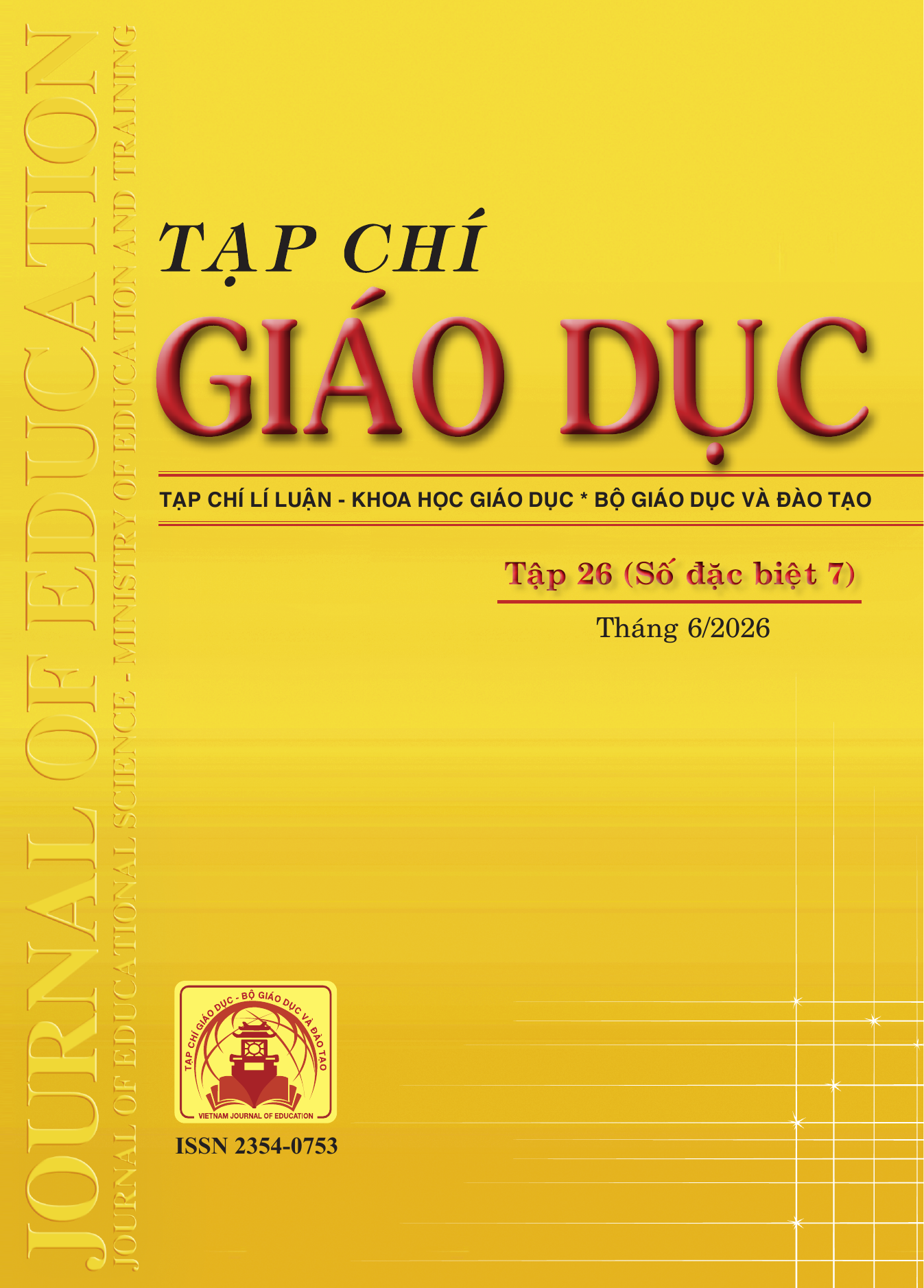
Đã Xuất bản
Cách trích dẫn
Số
Chuyên mục
Giấy phép
Bản quyền (c) 2026 Tạp chí Giáo dục

Tác phẩm này được cấp phép theo Ghi nhận tác giả của Creative Commons Giấy phép quốc tế 4.0 .